
Showing posts with label Muay Thai. Show all posts

Tuesday, May 3, 2016

Fighting For The Right To Fight


L.A. Jennings provides valuable social and historical context on the participation by and influence of women in combat sports.

By Diane Curtis

Women have been engaged in combat sports for centuries. Today, the most dominant athlete alive is a female fighter — a thought that would have been unheard of in the not-so-distant past, when women in combat sports were derided, dismissed, and/or fetishized. This was no accident of history; rather, it was a rocky but steady climb of progression (and backlash) built upon the hard work, sacrifices, and triumphs of generations of competitive women who would not be denied. In every arena — that of public opinion, before athletic commissions, and in actual arenas — they fought for the right of all women to fight.
In She’s a Knockout!: A History of Women in Fighting Sports, author, scholar, and mixed martial arts fighter/trainer L.A. Jennings chronicles the lives, careers, and exploits of these trailblazing boxers, wrestlers, and martial artists, providing valuable social and historical context along the way.
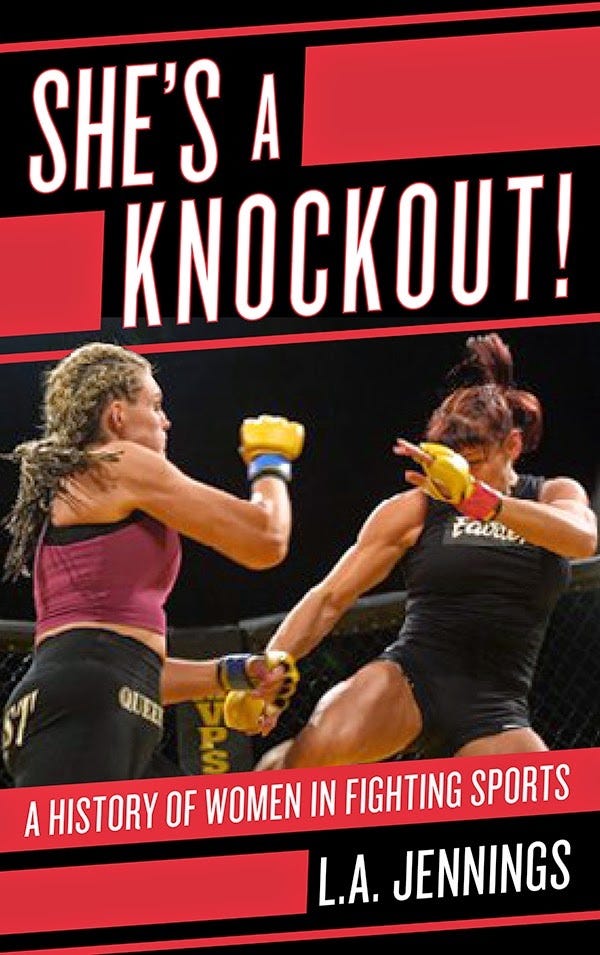


In her preface, Jennings rightly points out that, “if fighting is as old as man, then it is as old as woman, too.” Fighting, at its most basic level, is not and has never been the exclusive domain of the male sex. Fighting is instinctively coded into each and every one of us. It is the essence of life for every species, humans included. We are all fighting, in one way or another, and we always have been. Naturally, this applies to both men and women.
So it should come as no surprise that women have been interested in fighting sports — as spectators and practitioners — for far longer than popular memory would allow. Reading recent news articles and opinion pieces about such fighters as Holly Holm, Laila Ali, or Ronda Rousey, you would be under the distinct impression that women have only gotten the urge to lace up the gloves in the past few decades.
Jennings often had mixed emotions upon reading such articles. She was excited to see women’s combat sports move out of the margins and into the spotlight, but at the same time, seeing the rich histories of those same sports — and the women who built them — forgotten and ignored was deeply upsetting to her.
This book is her answer to that exclusion.
In her introduction, Jennings touches briefly upon the general history of boxing and how it has evolved over the centuries, as well as several styles of wrestling and martial arts traditions going all the way back to ancient Egypt, Greece, and Rome. If you’re unfamiliar with boxing beyond the Rocky series, it serves as an excellent primer. If you’re a long-time fight fan, there are new and fascinating tidbits throughout.
She then fast-forwards to the Georgian and Victorian eras, for which we have more reliable written records, and introduces us to Elizabeth Wilkinson Stokes, the “European Championess.” Stokes was an Englishwoman who began her career in 1722 by calling out fellow pugilist Hannah Hyfield via a public notice in the London Journal. (This is just one of the historical examples proving that, when it comes to boxing promotion, the more things change, the more they stay the same.) Stokes took approximately 22 minutes to triumph over Hyfield, and she fought for another six years after.
Jennings demonstrates a textbook Armbar submission technique on spouse and gym co-owner Mike Jennings. Photo by Bryan Carr, courtesy of L.A. Jennings.
In addition to fighter and fighting history, Jennings also provides valuable insight into the ways in which female fighters were regarded by society. Fighting sports were almost the exclusive domain of the lower classes, where women often had more freedom of movement within their social circles. They were expected to labor alongside men on farms, and, later, in factories, and so a woman expressing herself in a physical manner was not as foreign or repugnant an idea as it was to the upper classes.
This does not mean women had an easy path, or that they were readily accepted as professional prize fighters. They faced derision and road blocks at every turn. And when they were allowed to fight, it was a lurid spectacle meant to titillate men, typically the upper classes out for an evening. Any regard as legitimate fighters was still centuries away.
During the 1800s in America, prize fighting in general remained rare, intermittent, and below ground. The prudish Victorian middle class regarded it as barbaric, and the gambling that was always associated with it as immoral. But in the mid-1800s, the National Police Gazette, a rather sensational publication akin to today’s tabloids, began promoting and reporting upon matches, including women’s bouts. Boxing once again started to gain a foothold of legitimacy.
Fighting became more visible and organized. Match rules were established and agreed upon. Acceptance of the sport grew, as did the number of female fighters, although boxing remained at the margins of society.
The 20th century brought the rise of the Gibson Girl, and, at the same time, the sporting woman as society’s ideal of health and beauty. Girls’ boxing gyms were established so that middle- and upper-class girls and women could spar and remain fit. Most didn’t train for competition, but many of them learned the ins and outs of the sport and started to follow professional prize fighting as spectators. It was only a matter of time before they wanted the right to compete, too.
As in other social arenas, including suffrage, the right to work, and the right to a higher education, women’s participation in organized athletics gained momentum in the 20th century. From the 19th Amendment to Title IX, women steadily gained the right to full participation in all aspects of public life.
Jennings concludes her book with a chapter on recent history, and the area most casual fans are the most familiar with: that of women in today’s arena of mixed martial arts. And while UFC phenom “Rowdy” Ronda Rousey is responsible for much of their broad appeal nowadays, she is by no means the pioneer in this sport. Jennings introduces us to the other women fighters every fan should know, like Sarah Kaufman, Cris “Cyborg” Justino, Miesha Tate, Julie Kedzie and Gina Carano. The last two made history in the first-ever televised WMMA match.
Also, the UFC isn’t the first organization to promote women’s matches. In fact, it’s the last. The UFC simply built upon, borrowed, moved over, or bought out all of those who came before, including Hook-n-Shoot, Strikeforce and Elite XC. Now, they have their sights set on the all-female Invicta FC, nearly cleaning out their Strawweight division in order to build one of their own.
Four years after famously declaring women would “never” fight in the UFC, the organization’s President, Dana White, is now a thoroughly converted fan. And it feels as though further weight-class expansions, most likely Featherweight and Flyweight, are on the horizon. For women in MMA, the future looks bright.
So, while we all keep our eyes on the prize, Jennings reminds us that we shouldn’t forget the past, either:
“Despite risks of social alienation and even scuffles with the law, these historic female fighters were relentless in their pursuit of the sports they loved. Their courage reminds us that as important as it is to look forward to the next fight…it is just as crucial that we look back and remember the women who gave us the audacity to fight today.”

Q&A with the Author

L.A. Jennings. Photo by John Bosley, courtesy of the author.
D.E.C.: Could you start by telling us a little about yourself? Your general background, academic work, MMA training, and how they intersect?
L.A.J.: I started training [in] martial arts in 2003, and by 2006, the same year that I graduated from Florida State University with my B.A., I was competing in submission wrestling and kickboxing events. I earned my Masters in English from Florida State in 2008, all the while training and competing in martial arts, and a year later, moved to Denver, Colorado, to begin my doctoral program in Literary Studies at the University of Denver.
My academic work primarily focused on cultural theory, on what George Lipsitz called “the ordinary and the commonplace.” I am especially interested in gender studies and how meaning is generated through language, which is typically referred to as semiotics in academia. In my doctoral program, I realized that I was too busy to continue to compete, so I concentrated on coaching new fighters. My husband and I own a MMA gym in Denver called Train.Fight.Win. that provides fitness and MMA training in an egalitarian, gender-neutral environment.
My graduate student studies neatly coincided with my increasing interest in martial arts. I was training in a nearly all-male professional MMA gym, and I viewed all of my training and interactions through the theory I read in class, from Roland Barthes to Jacques Lacan to Judith Butler. I wrote a great deal about feminism, especially examining how powerful female characters, such as the femme fatale, are framed through formulaic narrative devices. I saw parallels in the way that the narrative structure of a hard-boiled detective novel, a closed system of meaning, limited the power of the femme fatale, similar in my mind to how the mixed martial arts community marginalized female fighters. Yes, a woman could participate in fighting (or, in the novel’s case, crime), but she would always be limited by the rules and structure of the world in which she operated. For female fighters, when I was competing, that meant the UFC (and in the hard-boiled detective novel, that meant the confines of the narrative’s functionality).
D.E.C.: What inspired you to write this? What impact do you hope it will have?
L.A.J.: I love history, and as I became more deeply engrossed in training, especially when I was first learning catch wrestling, I began to look for famous female fighters as inspiration. I found that I had to dig through a lot of hyperbole and inaccuracies in order to learn about the women who came before me in the sport. I want to tell everyone who loves fighting sports, male and female, that women had a long and storied history that impacted how MMA is practiced and produced today.
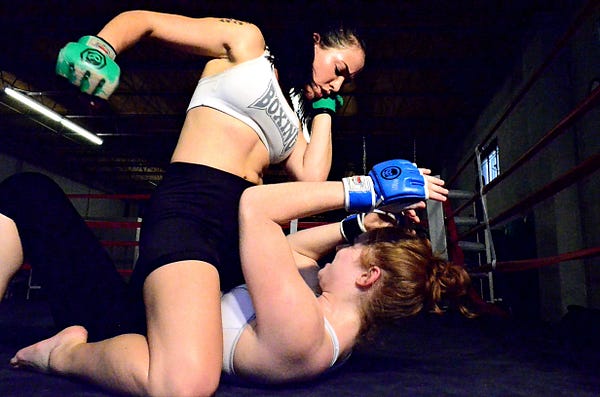
Jennings “Grounds & Pounds” Mariah Markus, one of her students at Train.Fight.Win. Photo by Bryan Carr, courtesy of the L.A. Jennings.
As an academic, I had access to libraries and databases that allowed me to thoroughly research the history of female fighters. It was a rigorous process, but I constantly experienced moments of delight when I would find an obscure article or create a connection to something happening in the fighting world today.
I hope that the book reveals the way that women’s history is often ignored, misconstrued, or intentionally hidden in order to create the myth that certain activities, such as fighting, have always been a man’s domain.
D.E.C: You write about the "Centerfold Imperative" for many women athletes. Do you think this is a double-edged sword for women who are judged harshly either way — sort of "damned if you do; damned if you don't?" Do you support the women athletes who choose to do this? If so, under what, if any, conditions? Or do you feel it actually does more harm than good, that there really is such a thing as bad publicity?
L.A.J.: I absolutely support an individual woman’s right to participate in any type of promotion she wishes. The problem is when women who are very talented do not receive the same opportunities as their more conventionally attractive counterparts because they do not conform to the beauty ideal. I do not think athletes who do pin-up or Playboy photoshoots should be condemned at all. But I do think that advertisers, such as Reebok, should be called out for only choosing conventionally attractive women to represent their sport.
D.E.C.: Now that women have a "place at the table" in the biggest global organization professional combat sports has to offer (UFC), what do you see as the next challenge? The next frontier?
L.A.J.: The next challenge is to make sure that all female fighters have a place in the UFC. Right now, only Strawweight and Bantamweight fighters are represented. It is not coincidental that these particular weight classes are populated by women who are an ideal size according to American beauty standards.
D.E.C.: One of the cornerstones of a sport's rise to legitimacy and the mainstream is a robust and well-managed youth development program. But "kids fighting in a cage" is the current, sensationalized narrative. At what age do you think it's appropriate for kids to start training? To start competing? As the owner of a MMA gym, what would that look like to you? What competition and safety guidelines would you see implemented in such a program?
L.A.J.: This is an interesting question; my gym does not have a children’s program and I do not have (nor plan to have) children myself. But my inclination is to say that children’s MMA could be organized in a way that is similar to football programs for children. There would be a structure that would determine at what age particular moves or strikes would be permissible and undoubtedly, an emphasis on safety by requiring more robust safety gear than what is appropriate for adult, professional MMA.
DEC: You state in your intro that the scope of this work had to be narrowed. What, if anything, do you regret having to leave out? Do you have plans for future works to expand on this subject and include that which you omitted this time around?
L.A.J.: I would have loved to do a more worldwide survey of women in fighting sports so that I could speak more as to how female fighters are positioned in other countries. However, I also think that would have been problematic. As an academic, I am perhaps overly concerned with my position and very hesitant to put myself in a situation where I would be ‘speaking for’ or representing women in other countries. For example, I would love to have included more about Muay Thai and the gender politics of Thailand’s fight scene, but it felt inappropriate since I would be looking at it as a complete outsider through an occidental lens. One of my dear friends, Sylvie von Duuglas-Ittu, has been living and fighting in Thailand for the past three years and is a much more informed voice on Muay Thai. Thus, while I did regret that the book was so focused on American and European history, it was probably for the best.
Currently, I am working with a nonprofit in Denver that provides services for women, children, and transgendered individuals experiencing poverty or homelessness. This is my passion project, so I have no plans to write anything lengthy for the next year or so. However, I do want to write an official history of MMA that will be a deep dive into the cultural history and implications of the sport.

She’s a Knockout!: A History of Women in Fighting Sports is available through amazon and other online retailers. If you’re heading out to pick up Ronda Rousey’s My Fight/Your Fight this week do yourself a favor and buy this, too.
  • Go to the profile of Diane E. Curtis

    Diane E. Curtis

    Atlanta-based Blogger and Web & Social Marketing Consultant. Former Academic, aspiring Sports Writer, eternal Geek Girl. http://dianeecurtis.com
  • Diane E. Curtis

    Wednesday, August 20, 2014

    The book is now available for pre-order!

    http://www.amazon.com/Shes-Knockout-History-Fighting-Sports/dp/1442236434


    I am working on a new website for the book, so Pugilista will be moving in the next few weeks. Until then, check out the book description on Amazon or review my articles on Fightland!

    Thursday, December 19, 2013

    The "First" Male vs Female Fight to take place in Brazil on December 20th

    Check out my article on Fightland:

    The book continues to grow; four chapters down and three to go!

    Train hard and keep your hands up
    -L.A.

    A Feminist Scholar on Tomorrow Night's Possible Mixed-Gender Fight

    Fightland Blog

    By L.A. Jennings
     
    Tomorrow night, MMA promotion Shooto Brazil claims they will make history by putting on the first mixed-gender fight in history, between Juliana Velasquez and Emerson Falcao. Reaction in the MMA community has been resoundingly negative since the announcement was made earlier this week, with most people expressing concern about Velasquez’s welfare and criticism of Falcao. Some critics have decried the event as a mere publicity stunt and bemoaned the impression such a fight will leave on the minds of a generally still-MMA-skeptical public.

    But while Shooto claims that they are the first-ever promoter of a male/female fight, this type of event actually isn’t unprecedented in the fight world. While doing research for my book on the history of women in fighting sports, I’ve found more than a dozen references to mixed-gender fights. The archives don’t suggest that mixed-gender fights were common, but there is precedence in pugilistic history. There are cases of men fighting women in boxing and wrestling matches as far back as the 16th century. And these bouts weren’t necessarily publicity stunts; the literature we have in numerous archives only mentions the fights after they occurred, rather than before, meaning they weren't only being mentioned to sell tickets. And in many cases, the women won. I read only yesterday about a French woman in the early 20th century who knocked out three men in succession. There is also an account of a famous female wrestler who regularly beat young men in the catch-as-catch-can style into her 70s.

    One can also point to the famous "Battle of the Sexes" tennis match between Billie Jean King and Bobby Riggs in 1973 for precedence. Granted, there isn’t the threat of bodily injury in tennis that there is in a MMA fight, but at the time the media and general public expressed a number of fears and concerns that are being echoed in criticisms of tomorrow’s Shooto 45 match: that the female competitor might get injured because she is “weaker” than her male counterpart; that it won't be a fair fight because the man will feel guilty if he goes as hard as he normally would.
    But one of the more problematic critiques being expressed is that any fight between a man and a woman will be reminiscent of domestic abuse. Regardless of its intent, this type of thinking actually supports the arguments made by MMA opponents that the sport as a whole is inherently violent and negative and should be banned.

    MMA is a sport, with rules and referees. Juliana Velasquez and Emerson Falcao fighters are both athletes, and they’re entering in the cage on their own volition. Comparing their fight to domestic abuse is problematic because doing so suggests that women willingly endure partner violence. Not only is this attitude extremely demoralizing and unfair to victims of domestic abuse; it also yokes the sport of MMA with the language of criminal assault and battery. And that, in my opinion, is a slippery slope: By equating MMA with criminality in any way, regardless of how we may feel about the rightness or fairness of a mixed-gender fight, we only provide leverage for the critics who have used the worst kind of alarmist language to prevent places like New York State from legalizing the sport.

    Friday, July 5, 2013

    Fitspo Memes - The Pugilista Edition

    A couple of months ago, one of my friends found this little gem on a Facebook "Gym Motivation" page:

    https://www.facebook.com/photo.php?fbid=360021220774966&set=a.107651092678648.14508.107648636012227&type=1&theater
    Recognize her?  Yeah...that is me.  And no, I did not create this meme, nor have I ever spoke this asinine quote.  So what the hell?

    In the virtual Pinterest and Facebook world, countless women (and men, too) view pages, like the one above, that promote images of "health and fitness."  And I put "health" in quotation marks, because a number of these memes promote disordered eating and thinking and are, in my opinion, the opposite of health.

    Many of these memes rely on shaming to put forth their message.  I will not directly post to any of these images, but here are a few of the quotes imposed upon pictures of very lean women:

    "Tears will get your sympathy.  Sweat will get you results."

    "Success trains. Failure complains."

    "This is what dedication looks like"

    That final one is especially problematic to me.  You can be dedicated without abs.  You can be determined without a thigh-gap.  And you can be worthwhile without large glutes.

    I know a lot of people find "Strong is the New Skinny" motivating, but to me, it is just as degrading and shaming as any other beauty paradigm.

    So what is my complaint?  Several of my friends have said that they would be flattered to have their picture turned into a fitness meme.  And I understand that desire.  But it is this quote, this idea that my 'dreams' are somehow wrapped up in my abs or arms or thighs that truly bothers me.  My 'dreams' are not to have nice abs and to conform to some other person's standards of beauty, but to finish my doctorate (done!), write my book, teach the sport that I love.  I dream of being a good person, of motivating people through my actions, not my body.

    If "Female Gym Motivation" wanted to just post my picture, preferably the original and not this odd, darkened version*, I would be okay with that.  But adding this quote somehow made me feel like the interwebs was attempting to rewrite the totality of my existence.  I have gone from a Professor and Coach, to a vapid and cliched trope. And maybe I am just a wee bit sensitive, but I already detest fitspo memes, and being made into one makes me feel, well, shamed.


    *Notice how they used a strange effect on the meme to accentuate my muscles.  It also gives me the look of having rolled around in the mud for several hours.

    Wednesday, September 26, 2012

    Shin Guard Round-Up

    The purpose of shin guards is two-fold:  to protect your own shins and to protect your training partners. Most gyms want trainees to wear shin guards even if they are MMA fighters.  Finding shin guards that fit is hard for everyone but especially for women.  In this post I review four pairs of shin guards that are regularly worn by the girls at my gym.

    The problem most shorter people have is finding a shin guard that fits the tibia.  Many 'regular' shin guards hit above the bend of the knee and can hinder movement.  Also if the foot guard is too large it can make it painful to kick.

    Most shin guards are made to be either slip-on or with hook and loops in the back.  Both have their advantages and disadvantages but anecdotally I see people having to adjust the hook and loop more than the slip-ons.  

    Tuesday, September 11, 2012

    Product Reviews and Peri-Workout Supplementation

    Hi Guys!  As I finish up this dissertation and prepare to start writing my book on female fighters, I am going to try to maintain a steady stream of product reviews for the blog.  I am the kind of girl who has to read reviews on a product before I buy and I figure there are a lot of y'all out there who like to do the same. 

    The following reviews will be coming down the pipeline over the next couple of weeks:
    -Tussle Fight Gear Vale Tudo shorts and sports bra
    -Fighter Girls Vale Tudo shorts
    -Jaco long sleeve rashguard
    -Shin guards round-up

    -Please let me know if there is any other gear you would like reviewed or any gear you have tried recently.  

    Peri-Workout Supplementation

    Several weeks ago the schedule at our gym changed.  On Tuesdays and Thursdays I teach three one-hour classes in a row:  women's kickboxing, fighter conditioning and striking strategy.  Each of these classes are very physically demanding and even if I don't train all of them I still feel tuckered out by the time that last class rolls around. 

    I am not really in to using workout supplementation; I eat a lot of food throughout the day and usually that is enough to get me through my workout and back home for dinner.  However, this three hour session has been kicking my ass so I decided to follow the advice I give my own clients and concoct a drink I can take down before the striking strategy class.

    Peri-Workout supplementation is taken during a workout.  For this type of high intensity, glucose-depleting training I recommend clients take a 2:1 ratio of carbohydrates to protein in the form of a shake.  However, right now I am trying to lean out a little more and increase my muscle mass so I am doing a little less carbs and more protein.  I feel like a nerd for jumping on the coconut water bandwagon but damn if it isn't delicious.  Plus juice gives me heartburn.

    L.A.'s Peri-Workout shake

    http://www.onedrinks.com/
    This shake contains equal parts carbohydrate and protein.  Again, I think it is important to eat adequate amounts of protein and carbohydrate at least two hours pre-workout when doing a very intensive training session.  I use this shake during my Tuesday/Thursday sessions and on Saturday between lifting and running sprints. 

    8oz O.N.E. coconut water
    1/2 scoop plain protein powder
    3-4 ice cubes

    Carbs:  11g
    Protein:  10g
    Fat:  0g
    100 Calories total


    What type of supplementation do you use during your training sessions? 

    Tuesday, August 14, 2012

    The Book

    I have been missing from this blog for three reasons.
    1.  I am writing my dissertation
    2.  I am writing articles for Fighter Girls!  Check out www.FighterGirls.com to see my column Fight Camp!
    3.  I am writing a book!  On female fighters! Squeal! 

    Let's go through these

    Tuesday, April 10, 2012

    Zingano Fight Camp

    Just checking in!  I have been frantically writing and working on an upcoming project, which I hope to share within the next month or so.  Until then, I am training, finishing my very last class EVER and working on my dissertation, looking forward to the day when I can call myself "Dr. J" or something to that effect.  Last week, however, I took a break to train with some very important ladies in the world of WMMA.

    Several weeks ago Cat Zingano announced her gym would be hosting a Women's Fight Camp for her and Randi Miller's preparation for the upcoming Invicta fights.  I jumped on the chance to train with Cat and other talented women and gained incredible experience in the process.

    Randi, Shelley, L.A. and Cat
    The first morning we trained submission wrestling and Muay Thai with Cat's husband, black belt Mauricio Zingano, and Kru Sakmongkol.  I got to roll with Randi and Cat, which was hilarious and humbling at the same time, and spar with Shelley, who recently competed in the Golden Gloves.

    Later that day, we returned to the gym to work on Muay Thai with Kru Sakmongkol and who was there but my friend and first interviewee Sylvie! 

    Sylvie, Cat and L.A.
    Sylvie was hanging out with her folks in Boulder before heading out to Thailand to train for a full year!  Sylvie and I got to meet for the first time, which included sparring and working on clinch drills. 

    L.A., Shelley, Kim, Kru, Randi, Cat and Sylvie
    It was a great training session as you can see from my top knot, which indicates that I am too damn hot to have my hair anywhere near my neck.  Check out Sylvie's blog and follow her adventures as she trains in Thailand!  I am so excited for her.

    MMARising
    At this point I think I should stop and note just amazing these women are.  I have watched Cat Zingano roll at several local grappling tournaments and she is strong, dynamic and aggressive!  I was slightly nervous about meeting her at the camp but she immediately impressed me as being kind, funny and encouraging.  She thanked me several times for coming to the camp, even though rolling with me was probably no different than grappling with a six-year-old.  Although Cat had to drop out of the upcoming Invicta fight, I cannot wait to see her compete in the future.


    TheMat
    I was also really impressed by Randi Miller.  An Olympic bronze medalist, Randi is a freaking American hero and is, like Cat, very encouraging and more than willing to share her expertise.  She is making her MMA debut at Invicta and it was going to be epic!  Also...doesn't she have the best smile?


    L.A., Barb, Kim and Randi

    The next two days consisted of more training although I did not get any pictures.  On the third day, Randi taught a wrestling class that was absolutely incredible!  I was super excited to work with 125lb MMA fighter Barb Honchak, who is gracious, kind and very strong.  I love wrestling and was thrilled to work with an Olympian.

    Although I eventually had to cut out of the camp early (dissertation director was not happy with my lack of material for the week), I really enjoyed training at the Zingano gym and working with Cat, Randi, Barb and the rest of the girls.  Cat and I talked about how difficult it was for her to find female training partners which can be detrimental when preparing for a fight.  I hope that there will be more of these camps in the future.

    Check out the Zingano MMA gyms in Brighton and Broomfield, Colorado, where both Cat and Randi train:

    Also, the Invicta Fight Championships where Randi will make her MMA debut at the end of April

    Follow Cat on Facebook
    Check out Randi's website

    Monday, March 5, 2012

    The Aftermath: Rousey defeats Tate by her signature submission

    Esther Lin/Getty Images
     After all the build-up, the hype, the excitement and frustration, the fight between Ronda Rousey and Meisha Tate did exactly what I hoped it would do.  Saturday night's Strikeforce event demonstrated that female fighters have the skill, talent and aggression to put on an incredible show.  No one can doubt the legitimacy of Rousey and Tate and Sarah Kauffman and Alexis Davis as MMA fighters. 

    Thursday, February 23, 2012

    Inspiration Thursday: Invicta Fighting Championship


    It is tough for women to break into the professional fighting scene, especially when few venues cater to female fighters.  Invicta Fighting Championships is an all female fight promotion founded by Shannon Knapp and set to debue April 28.  Headlining the event will be French MMA fighter Romy Ruyssen in her rematch with Dutch MMA fighter Marloes Coenen.  I cannot wait to check out this event and watch talented fighters from Strikeforce, Bellator and other promotions square off. 

    Tuesday, February 21, 2012

    New FighterGirls MMA gloves

    It has been almost a month since I last posted and although I am mildly embarrassed, I do think I have good reason.  School has been kicking my ass; from teaching to taking class to writing my dissertation, I've spent the majority of my time lately sitting in front of the computer researching and writing.  I do have a couple of things brewing in an effort to enter the world of MMA journalism on a professional level, which is both exciting and terrifying.  In the meantime, I will be doing short posts about training, competing and of course, the upcoming Tate/Rousey battle.

    How freaking sick are these?

    Tuesday, January 17, 2012

    The Paleo Diet: Two years in review

    Also known as 
    "There and Back Again:  A Paleo Tale by L.A. Jennings"

    Paleo in April 2011, then back to grains in early June 2011
    This is the story of my experience with the Paleo diet from September 2009 to April 2011.  This is my personal experience and is not meant to critique the diet as a whole.  Rather, I wanted to share with the other souls out there who, like me, believed heartily in the diet yet found it did not fulfill the expectation of improving health and physique.  I know many people who have had success with the lifestyle but perhaps it is not the best for people who, like me, train a highly demanding sport. 

    Monday, January 16, 2012

    Dropping In: A guide to visiting other schools and gyms


    After three weeks of random holiday travel, I'm finally back home to remain for hopefully the next couple of months.  While I enjoy visiting family and friends, the regularity of my training was disrupted and I am eager to get back into the gym full-time.  During my travels, I had the opportunity to pop into several gyms for workouts, all of which were fun and enlightening.  Thus, I decided to write a short guide on how to visit gyms and represent yourself, your school and the art.

    Wednesday, December 7, 2011

    Product Review: Jaco Hybrid Training Tights

    http://www.jacoclothing.com/us/womens-training-tights.html
    Jaco is a new MMA apparel company that has become wildly popular amongst fighters and fitness enthusiasts alike.  My husband has a pair of the Filipino flag board shorts, which he loves, so I was eager to try out their Womens apparel.  This is a review of the Hybrid compression tights and I will post a review in the future of the long-sleeved training top.

    Monday, December 5, 2011

    Women-Only Training: Separating the boys from the girls

    Coaching a new boxer

    I have always enjoyed training with the guys.  Not because they necessarily train harder or are more intense or more technical, but because I don't give a shit about the gender of my training partners.  I like to work with people who have good attitudes, who are not dismissive, egotistical or negative.  I've had my share of asshole guys who hit on you while you are in the guard or who snipe at your dedication to training a 'male' sport.  However, the majority of my training experience has been very positive, which is probably why nearly eight years later, I am still training. 

    Many MMA and BJJ gyms offer separate classes for women and I personally teach a women's striking class at my gym.  I am still undecided about whether or not I agree with separating the sexes, although from a business perspective, it definitely makes sense.
     

    Tuesday, November 29, 2011

    Interview: 16-year-old Kickboxer Brittney Updike

    The darling but tough Brittney Updike

    At 16 years old, Brittney Updike is an up-and-coming kickboxer with an impressive record of 2-1.  Although young, Brittney was incredibly polite and well-spoken and absolutely in love with the sport she practices.  It was fascinating to talk to a young girl who trains and competes.  She also had a hilarious story about fighting an ex-boyfriend.  Check it out!


    Tuesday, November 22, 2011

    Product Review: Lilac Black Football Pants


    I've been eyeing these Lilac Black football pants listed on Title's website for a while now, so when I received a couple to order through their website, I was thrilled to give them a try.  I am not sure exactly why Lilac Black, a small women's sports apparel company, is sold through Title Boxing, because there is nothing particularly combative about their gear.  However, these pants were so hella cute, I couldn't resist buying a pair. 

    Wednesday, November 16, 2011

    Product Review: Atama Vale Tudo Shorts


    I have a weakness for vale tudo shorts.  I love the comfort of wearing spandex shorts, especially the feeling of fabric creating a buffer between my thighs which always have rubbed together.  Although I detest running, I find spandex preferable to traditional loose running shorts because it keeps my thighs from chaffing.  Vale tudo shorts are perfect for kickboxing, wrestling, grappling and all sorts of cross-training.  They go great under a kimono and the extra band around the thighs keep them from running up into your crotch. 

    Wednesday, October 26, 2011

    The Great Hair Battle!

    Crazy face, yes.  Great hair, also yes. 
    Sometimes, I wish I was a dude.  Not very often...in fact, it lasts for approximately two seconds while I glance at my husbands shaved head and his effortless boxing, then turn my attention back to the hair in my face and the pads in front of me.  As a fighter, I am always dealing with a mass of hair and trying to figure out the best way to keep it out of my eyes.  It is enough to make me want to shave my head...again, as a fighter. 

    Sunday, October 23, 2011

    Product Review: Wet Effect Fight Shorts

    Thank you mouthpiece for protecting my teeth and making me look like a duck

    Over the years I've owned a number of fight shorts, from the first version of the Sprawl short to later incarnations by Fighting, Jaco and Truth. All of these board shorts were made for men and thus, hit right around the knee on my rather short legs. I've been looking for some time for a pair of board shorts for women that were not pink or camouflaged, not that there is anything wrong with those design aspects, but because in the gym, I like to wear black. Therefore, I was delighted to see that Wet Effect, a long-time purveyor of fight shorts that could be purchased blank or emblazoned with a personal or company logo, was now making board shorts for women.