
L.A. Jennings provides valuable social and historical context on the participation by and influence of women in combat sports.
By Diane Curtis
Women have been engaged in combat sports for centuries. Today, the most dominant athlete alive
is a female fighter — a thought that would have been unheard of in the
not-so-distant past, when women in combat sports were derided,
dismissed, and/or fetishized. This was no accident of history; rather,
it was a rocky but steady climb of progression (and backlash) built upon
the hard work, sacrifices, and triumphs of generations of competitive
women who would not be denied. In every arena — that of public opinion,
before athletic commissions, and in actual arenas — they fought for the
right of all women to fight.
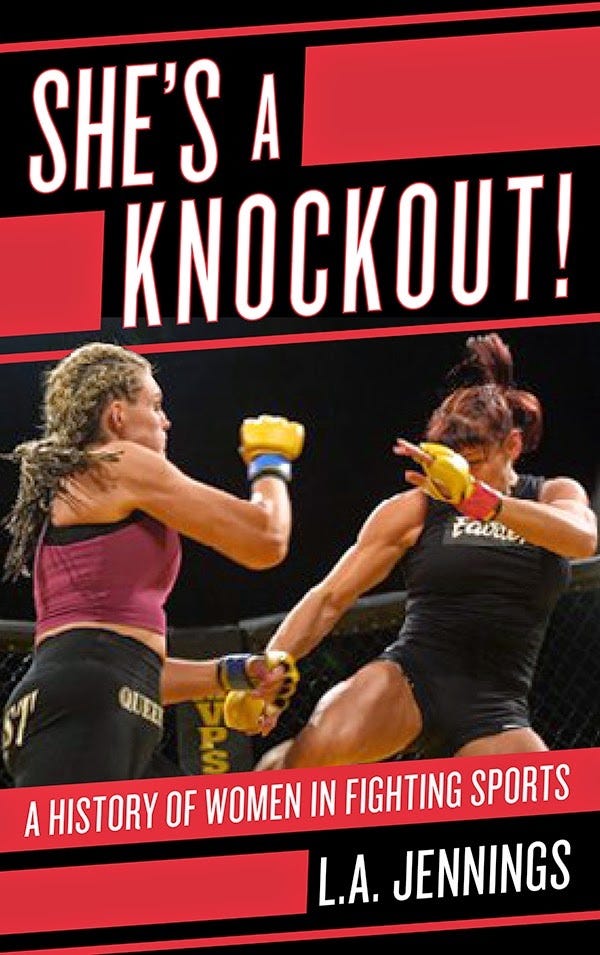
In She’s a Knockout!: A History of Women in Fighting Sports,
author, scholar, and mixed martial arts fighter/trainer L.A. Jennings
chronicles the lives, careers, and exploits of these trailblazing
boxers, wrestlers, and martial artists, providing valuable social and
historical context along the way.
In
her preface, Jennings rightly points out that, “if fighting is as old
as man, then it is as old as woman, too.” Fighting, at its most basic
level, is not and has never been the exclusive domain of the male sex.
Fighting is instinctively coded into each and every one of us. It is the
essence of life for every species, humans included. We are all
fighting, in one way or another, and we always have been. Naturally,
this applies to both men and women.
So
it should come as no surprise that women have been interested in
fighting sports — as spectators and practitioners — for far longer than
popular memory would allow. Reading recent news articles and opinion
pieces about such fighters as Holly Holm, Laila Ali, or Ronda Rousey,
you would be under the distinct impression that women have only gotten
the urge to lace up the gloves in the past few decades.
Jennings
often had mixed emotions upon reading such articles. She was excited to
see women’s combat sports move out of the margins and into the
spotlight, but at the same time, seeing the rich histories of those same
sports — and the women who built them — forgotten and ignored was
deeply upsetting to her.
This book is her answer to that exclusion.
In
her introduction, Jennings touches briefly upon the general history of
boxing and how it has evolved over the centuries, as well as several
styles of wrestling and martial arts traditions going all the way back
to ancient Egypt, Greece, and Rome. If you’re unfamiliar with boxing
beyond the Rocky series, it serves as an excellent primer. If you’re a
long-time fight fan, there are new and fascinating tidbits throughout.
She
then fast-forwards to the Georgian and Victorian eras, for which we
have more reliable written records, and introduces us to Elizabeth
Wilkinson Stokes, the “European Championess.” Stokes was an Englishwoman
who began her career in 1722 by calling out fellow pugilist Hannah
Hyfield via a public notice in the London Journal.
(This is just one of the historical examples proving that, when it
comes to boxing promotion, the more things change, the more they stay
the same.) Stokes took approximately 22 minutes to triumph over Hyfield,
and she fought for another six years after.

In
addition to fighter and fighting history, Jennings also provides
valuable insight into the ways in which female fighters were regarded by
society. Fighting sports were almost the exclusive domain of the lower
classes, where women often had more freedom of movement within their
social circles. They were expected to labor alongside men on farms, and,
later, in factories, and so a woman expressing herself in a physical
manner was not as foreign or repugnant an idea as it was to the upper
classes.
This
does not mean women had an easy path, or that they were readily accepted
as professional prize fighters. They faced derision and road blocks at
every turn. And when they were allowed to fight, it was a lurid
spectacle meant to titillate men, typically the upper classes out for an
evening. Any regard as legitimate fighters was still centuries away.
During
the 1800s in America, prize fighting in general remained rare,
intermittent, and below ground. The prudish Victorian middle class
regarded it as barbaric, and the gambling that was always associated
with it as immoral. But in the mid-1800s, the National Police Gazette,
a rather sensational publication akin to today’s tabloids, began
promoting and reporting upon matches, including women’s bouts. Boxing
once again started to gain a foothold of legitimacy.
Fighting
became more visible and organized. Match rules were established and
agreed upon. Acceptance of the sport grew, as did the number of female
fighters, although boxing remained at the margins of society.
The 20th century brought the rise of the Gibson Girl,
and, at the same time, the sporting woman as society’s ideal of health
and beauty. Girls’ boxing gyms were established so that middle- and
upper-class girls and women could spar and remain fit. Most didn’t train
for competition, but many of them learned the ins and outs of the sport
and started to follow professional prize fighting as spectators. It was
only a matter of time before they wanted the right to compete, too.
As
in other social arenas, including suffrage, the right to work, and the
right to a higher education, women’s participation in organized
athletics gained momentum in the 20th century. From the 19th Amendment
to Title IX, women steadily gained the right to full participation in
all aspects of public life.
Jennings
concludes her book with a chapter on recent history, and the area most
casual fans are the most familiar with: that of women in today’s arena
of mixed martial arts. And while UFC phenom “Rowdy” Ronda Rousey is
responsible for much of their broad appeal nowadays, she is by no means
the pioneer in this sport. Jennings introduces us to the other women
fighters every fan should know, like Sarah Kaufman, Cris “Cyborg”
Justino, Miesha Tate, Julie Kedzie and Gina Carano. The last two made
history in the first-ever televised WMMA match.
Also, the UFC isn’t the first organization to promote women’s matches. In fact, it’s the last.
The UFC simply built upon, borrowed, moved over, or bought out all of
those who came before, including Hook-n-Shoot, Strikeforce and Elite XC.
Now, they have their sights set on the all-female Invicta FC, nearly
cleaning out their Strawweight division in order to build one of their
own.
Four
years after famously declaring women would “never” fight in the UFC, the
organization’s President, Dana White, is now a thoroughly converted
fan. And it feels as though further weight-class expansions, most likely
Featherweight and Flyweight, are on the horizon. For women in MMA, the
future looks bright.
So, while we all keep our eyes on the prize, Jennings reminds us that we shouldn’t forget the past, either:
“Despite risks of social alienation and even scuffles with the law, these historic female fighters were relentless in their pursuit of the sports they loved. Their courage reminds us that as important as it is to look forward to the next fight…it is just as crucial that we look back and remember the women who gave us the audacity to fight today.”
Q&A with the Author

D.E.C.: Could
you start by telling us a little about yourself? Your general
background, academic work, MMA training, and how they intersect?
L.A.J.: I
started training [in] martial arts in 2003, and by 2006, the same year
that I graduated from Florida State University with my B.A., I was
competing in submission wrestling and kickboxing events. I earned my
Masters in English from Florida State in 2008, all the while training
and competing in martial arts, and a year later, moved to Denver,
Colorado, to begin my doctoral program in Literary Studies at the
University of Denver.
My
academic work primarily focused on cultural theory, on what George
Lipsitz called “the ordinary and the commonplace.” I am especially
interested in gender studies and how meaning is generated through
language, which is typically referred to as semiotics in academia. In my
doctoral program, I realized that I was too busy to continue to
compete, so I concentrated on coaching new fighters. My husband and I
own a MMA gym in Denver called Train.Fight.Win. that provides fitness
and MMA training in an egalitarian, gender-neutral environment.
My
graduate student studies neatly coincided with my increasing interest
in martial arts. I was training in a nearly all-male professional MMA
gym, and I viewed all of my training and interactions through the theory
I read in class, from Roland Barthes to Jacques Lacan to Judith Butler.
I wrote a great deal about feminism, especially examining how powerful
female characters, such as the femme fatale,
are framed through formulaic narrative devices. I saw parallels in the
way that the narrative structure of a hard-boiled detective novel, a
closed system of meaning, limited the power of the femme fatale,
similar in my mind to how the mixed martial arts community marginalized
female fighters. Yes, a woman could participate in fighting (or, in the
novel’s case, crime), but she would always be limited by the rules and
structure of the world in which she operated. For female fighters, when I
was competing, that meant the UFC (and in the hard-boiled detective
novel, that meant the confines of the narrative’s functionality).
D.E.C.: What inspired you to write this? What impact do you hope it will have?
L.A.J.: I
love history, and as I became more deeply engrossed in training,
especially when I was first learning catch wrestling, I began to look
for famous female fighters as inspiration. I found that I had to dig
through a lot of hyperbole and inaccuracies in order to learn about the
women who came before me in the sport. I want to tell everyone who loves
fighting sports, male and female, that women had a long and storied
history that impacted how MMA is practiced and produced today.
As
an academic, I had access to libraries and databases that allowed me to
thoroughly research the history of female fighters. It was a rigorous
process, but I constantly experienced moments of delight when I would
find an obscure article or create a connection to something happening in
the fighting world today.
I
hope that the book reveals the way that women’s history is often
ignored, misconstrued, or intentionally hidden in order to create the
myth that certain activities, such as fighting, have always been a man’s
domain.
D.E.C: You
write about the "Centerfold Imperative" for many women athletes. Do you
think this is a double-edged sword for women who are judged harshly
either way — sort of "damned if you do; damned if you don't?" Do you
support the women athletes who choose to do this? If so, under what, if
any, conditions? Or do you feel it actually does more harm than good,
that there really is such a thing as bad publicity?
L.A.J.: I
absolutely support an individual woman’s right to participate in any
type of promotion she wishes. The problem is when women who are very
talented do not receive the same opportunities as their more
conventionally attractive counterparts because they do not conform to
the beauty ideal. I do not think athletes who do pin-up or Playboy photoshoots should be condemned at all. But I do think that advertisers, such as Reebok, should be called out for only choosing conventionally attractive women to represent their sport.
D.E.C.: Now
that women have a "place at the table" in the biggest global
organization professional combat sports has to offer (UFC), what do you
see as the next challenge? The next frontier?
L.A.J.: The
next challenge is to make sure that all female fighters have a place in
the UFC. Right now, only Strawweight and Bantamweight fighters are
represented. It is not coincidental that these particular weight classes
are populated by women who are an ideal size according to American
beauty standards.
D.E.C.:
One of the cornerstones of a sport's rise to legitimacy and the
mainstream is a robust and well-managed youth development program. But "kids fighting in a cage"
is the current, sensationalized narrative. At what age do you think
it's appropriate for kids to start training? To start competing? As the
owner of a MMA gym, what would that look like to you? What competition
and safety guidelines would you see implemented in such a program?
L.A.J.: This
is an interesting question; my gym does not have a children’s program
and I do not have (nor plan to have) children myself. But my inclination
is to say that children’s MMA could be organized in a way that is
similar to football programs for children. There would be a structure
that would determine at what age particular moves or strikes would be
permissible and undoubtedly, an emphasis on safety by requiring more
robust safety gear than what is appropriate for adult, professional MMA.
DEC: You
state in your intro that the scope of this work had to be narrowed.
What, if anything, do you regret having to leave out? Do you have plans
for future works to expand on this subject and include that which you
omitted this time around?
L.A.J.: I
would have loved to do a more worldwide survey of women in fighting
sports so that I could speak more as to how female fighters are
positioned in other countries. However, I also think that would have
been problematic. As an academic, I am perhaps overly concerned with my
position and very hesitant to put myself in a situation where I would be
‘speaking for’ or representing women in other countries. For example, I
would love to have included more about Muay Thai and the gender
politics of Thailand’s fight scene, but it felt inappropriate since I
would be looking at it as a complete outsider through an occidental
lens. One of my dear friends, Sylvie von Duuglas-Ittu, has been living
and fighting in Thailand for the past three years and is a much more
informed voice on Muay Thai. Thus, while I did regret that the book was
so focused on American and European history, it was probably for the
best.
Currently,
I am working with a nonprofit in Denver that provides services for
women, children, and transgendered individuals experiencing poverty or
homelessness. This is my passion project, so I have no plans to write
anything lengthy for the next year or so. However, I do want to write an
official history of MMA that will be a deep dive into the cultural
history and implications of the sport.
She’s a Knockout!: A History of Women in Fighting Sports is available through amazon and other online retailers. If you’re heading out to pick up Ronda Rousey’s My Fight/Your Fight this week do yourself a favor and buy this, too.

Diane E. Curtis
Atlanta-based Blogger and Web & Social Marketing Consultant. Former Academic, aspiring Sports Writer, eternal Geek Girl. http://dianeecurtis.com

The Cauldron
Presented by Sports Illustrated®. (By way of Medium.)
Latest stories written by Diane E. Curtis
 4 min read41
 11 min read38
 4 min read6


