
Showing posts with label Opinion. Show all posts

Tuesday, May 3, 2016

Fighting For The Right To Fight


L.A. Jennings provides valuable social and historical context on the participation by and influence of women in combat sports.

By Diane Curtis

Women have been engaged in combat sports for centuries. Today, the most dominant athlete alive is a female fighter — a thought that would have been unheard of in the not-so-distant past, when women in combat sports were derided, dismissed, and/or fetishized. This was no accident of history; rather, it was a rocky but steady climb of progression (and backlash) built upon the hard work, sacrifices, and triumphs of generations of competitive women who would not be denied. In every arena — that of public opinion, before athletic commissions, and in actual arenas — they fought for the right of all women to fight.
In She’s a Knockout!: A History of Women in Fighting Sports, author, scholar, and mixed martial arts fighter/trainer L.A. Jennings chronicles the lives, careers, and exploits of these trailblazing boxers, wrestlers, and martial artists, providing valuable social and historical context along the way.
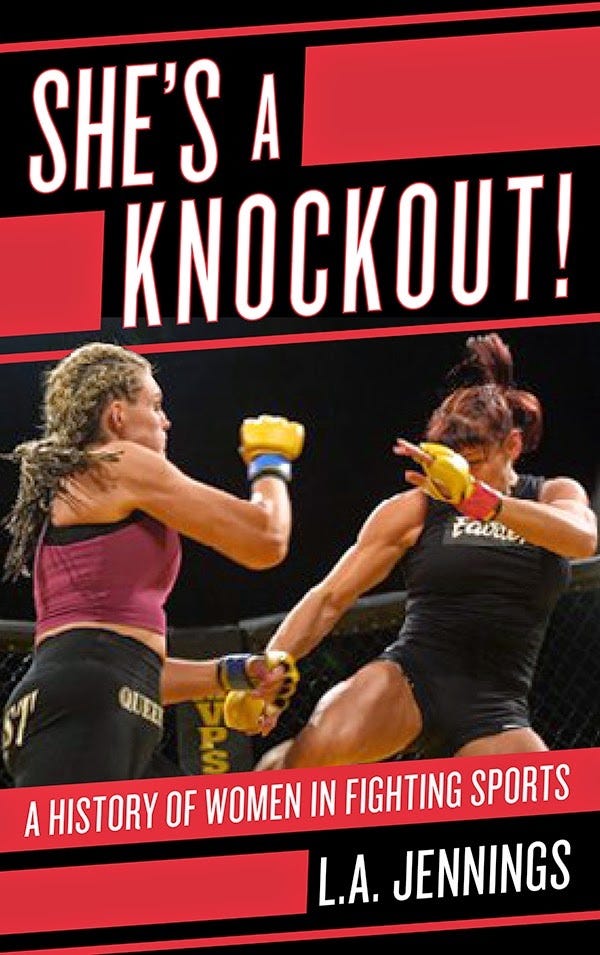


In her preface, Jennings rightly points out that, “if fighting is as old as man, then it is as old as woman, too.” Fighting, at its most basic level, is not and has never been the exclusive domain of the male sex. Fighting is instinctively coded into each and every one of us. It is the essence of life for every species, humans included. We are all fighting, in one way or another, and we always have been. Naturally, this applies to both men and women.
So it should come as no surprise that women have been interested in fighting sports — as spectators and practitioners — for far longer than popular memory would allow. Reading recent news articles and opinion pieces about such fighters as Holly Holm, Laila Ali, or Ronda Rousey, you would be under the distinct impression that women have only gotten the urge to lace up the gloves in the past few decades.
Jennings often had mixed emotions upon reading such articles. She was excited to see women’s combat sports move out of the margins and into the spotlight, but at the same time, seeing the rich histories of those same sports — and the women who built them — forgotten and ignored was deeply upsetting to her.
This book is her answer to that exclusion.
In her introduction, Jennings touches briefly upon the general history of boxing and how it has evolved over the centuries, as well as several styles of wrestling and martial arts traditions going all the way back to ancient Egypt, Greece, and Rome. If you’re unfamiliar with boxing beyond the Rocky series, it serves as an excellent primer. If you’re a long-time fight fan, there are new and fascinating tidbits throughout.
She then fast-forwards to the Georgian and Victorian eras, for which we have more reliable written records, and introduces us to Elizabeth Wilkinson Stokes, the “European Championess.” Stokes was an Englishwoman who began her career in 1722 by calling out fellow pugilist Hannah Hyfield via a public notice in the London Journal. (This is just one of the historical examples proving that, when it comes to boxing promotion, the more things change, the more they stay the same.) Stokes took approximately 22 minutes to triumph over Hyfield, and she fought for another six years after.
Jennings demonstrates a textbook Armbar submission technique on spouse and gym co-owner Mike Jennings. Photo by Bryan Carr, courtesy of L.A. Jennings.
In addition to fighter and fighting history, Jennings also provides valuable insight into the ways in which female fighters were regarded by society. Fighting sports were almost the exclusive domain of the lower classes, where women often had more freedom of movement within their social circles. They were expected to labor alongside men on farms, and, later, in factories, and so a woman expressing herself in a physical manner was not as foreign or repugnant an idea as it was to the upper classes.
This does not mean women had an easy path, or that they were readily accepted as professional prize fighters. They faced derision and road blocks at every turn. And when they were allowed to fight, it was a lurid spectacle meant to titillate men, typically the upper classes out for an evening. Any regard as legitimate fighters was still centuries away.
During the 1800s in America, prize fighting in general remained rare, intermittent, and below ground. The prudish Victorian middle class regarded it as barbaric, and the gambling that was always associated with it as immoral. But in the mid-1800s, the National Police Gazette, a rather sensational publication akin to today’s tabloids, began promoting and reporting upon matches, including women’s bouts. Boxing once again started to gain a foothold of legitimacy.
Fighting became more visible and organized. Match rules were established and agreed upon. Acceptance of the sport grew, as did the number of female fighters, although boxing remained at the margins of society.
The 20th century brought the rise of the Gibson Girl, and, at the same time, the sporting woman as society’s ideal of health and beauty. Girls’ boxing gyms were established so that middle- and upper-class girls and women could spar and remain fit. Most didn’t train for competition, but many of them learned the ins and outs of the sport and started to follow professional prize fighting as spectators. It was only a matter of time before they wanted the right to compete, too.
As in other social arenas, including suffrage, the right to work, and the right to a higher education, women’s participation in organized athletics gained momentum in the 20th century. From the 19th Amendment to Title IX, women steadily gained the right to full participation in all aspects of public life.
Jennings concludes her book with a chapter on recent history, and the area most casual fans are the most familiar with: that of women in today’s arena of mixed martial arts. And while UFC phenom “Rowdy” Ronda Rousey is responsible for much of their broad appeal nowadays, she is by no means the pioneer in this sport. Jennings introduces us to the other women fighters every fan should know, like Sarah Kaufman, Cris “Cyborg” Justino, Miesha Tate, Julie Kedzie and Gina Carano. The last two made history in the first-ever televised WMMA match.
Also, the UFC isn’t the first organization to promote women’s matches. In fact, it’s the last. The UFC simply built upon, borrowed, moved over, or bought out all of those who came before, including Hook-n-Shoot, Strikeforce and Elite XC. Now, they have their sights set on the all-female Invicta FC, nearly cleaning out their Strawweight division in order to build one of their own.
Four years after famously declaring women would “never” fight in the UFC, the organization’s President, Dana White, is now a thoroughly converted fan. And it feels as though further weight-class expansions, most likely Featherweight and Flyweight, are on the horizon. For women in MMA, the future looks bright.
So, while we all keep our eyes on the prize, Jennings reminds us that we shouldn’t forget the past, either:
“Despite risks of social alienation and even scuffles with the law, these historic female fighters were relentless in their pursuit of the sports they loved. Their courage reminds us that as important as it is to look forward to the next fight…it is just as crucial that we look back and remember the women who gave us the audacity to fight today.”

Q&A with the Author

L.A. Jennings. Photo by John Bosley, courtesy of the author.
D.E.C.: Could you start by telling us a little about yourself? Your general background, academic work, MMA training, and how they intersect?
L.A.J.: I started training [in] martial arts in 2003, and by 2006, the same year that I graduated from Florida State University with my B.A., I was competing in submission wrestling and kickboxing events. I earned my Masters in English from Florida State in 2008, all the while training and competing in martial arts, and a year later, moved to Denver, Colorado, to begin my doctoral program in Literary Studies at the University of Denver.
My academic work primarily focused on cultural theory, on what George Lipsitz called “the ordinary and the commonplace.” I am especially interested in gender studies and how meaning is generated through language, which is typically referred to as semiotics in academia. In my doctoral program, I realized that I was too busy to continue to compete, so I concentrated on coaching new fighters. My husband and I own a MMA gym in Denver called Train.Fight.Win. that provides fitness and MMA training in an egalitarian, gender-neutral environment.
My graduate student studies neatly coincided with my increasing interest in martial arts. I was training in a nearly all-male professional MMA gym, and I viewed all of my training and interactions through the theory I read in class, from Roland Barthes to Jacques Lacan to Judith Butler. I wrote a great deal about feminism, especially examining how powerful female characters, such as the femme fatale, are framed through formulaic narrative devices. I saw parallels in the way that the narrative structure of a hard-boiled detective novel, a closed system of meaning, limited the power of the femme fatale, similar in my mind to how the mixed martial arts community marginalized female fighters. Yes, a woman could participate in fighting (or, in the novel’s case, crime), but she would always be limited by the rules and structure of the world in which she operated. For female fighters, when I was competing, that meant the UFC (and in the hard-boiled detective novel, that meant the confines of the narrative’s functionality).
D.E.C.: What inspired you to write this? What impact do you hope it will have?
L.A.J.: I love history, and as I became more deeply engrossed in training, especially when I was first learning catch wrestling, I began to look for famous female fighters as inspiration. I found that I had to dig through a lot of hyperbole and inaccuracies in order to learn about the women who came before me in the sport. I want to tell everyone who loves fighting sports, male and female, that women had a long and storied history that impacted how MMA is practiced and produced today.

Jennings “Grounds & Pounds” Mariah Markus, one of her students at Train.Fight.Win. Photo by Bryan Carr, courtesy of the L.A. Jennings.
As an academic, I had access to libraries and databases that allowed me to thoroughly research the history of female fighters. It was a rigorous process, but I constantly experienced moments of delight when I would find an obscure article or create a connection to something happening in the fighting world today.
I hope that the book reveals the way that women’s history is often ignored, misconstrued, or intentionally hidden in order to create the myth that certain activities, such as fighting, have always been a man’s domain.
D.E.C: You write about the "Centerfold Imperative" for many women athletes. Do you think this is a double-edged sword for women who are judged harshly either way — sort of "damned if you do; damned if you don't?" Do you support the women athletes who choose to do this? If so, under what, if any, conditions? Or do you feel it actually does more harm than good, that there really is such a thing as bad publicity?
L.A.J.: I absolutely support an individual woman’s right to participate in any type of promotion she wishes. The problem is when women who are very talented do not receive the same opportunities as their more conventionally attractive counterparts because they do not conform to the beauty ideal. I do not think athletes who do pin-up or Playboy photoshoots should be condemned at all. But I do think that advertisers, such as Reebok, should be called out for only choosing conventionally attractive women to represent their sport.
D.E.C.: Now that women have a "place at the table" in the biggest global organization professional combat sports has to offer (UFC), what do you see as the next challenge? The next frontier?
L.A.J.: The next challenge is to make sure that all female fighters have a place in the UFC. Right now, only Strawweight and Bantamweight fighters are represented. It is not coincidental that these particular weight classes are populated by women who are an ideal size according to American beauty standards.
D.E.C.: One of the cornerstones of a sport's rise to legitimacy and the mainstream is a robust and well-managed youth development program. But "kids fighting in a cage" is the current, sensationalized narrative. At what age do you think it's appropriate for kids to start training? To start competing? As the owner of a MMA gym, what would that look like to you? What competition and safety guidelines would you see implemented in such a program?
L.A.J.: This is an interesting question; my gym does not have a children’s program and I do not have (nor plan to have) children myself. But my inclination is to say that children’s MMA could be organized in a way that is similar to football programs for children. There would be a structure that would determine at what age particular moves or strikes would be permissible and undoubtedly, an emphasis on safety by requiring more robust safety gear than what is appropriate for adult, professional MMA.
DEC: You state in your intro that the scope of this work had to be narrowed. What, if anything, do you regret having to leave out? Do you have plans for future works to expand on this subject and include that which you omitted this time around?
L.A.J.: I would have loved to do a more worldwide survey of women in fighting sports so that I could speak more as to how female fighters are positioned in other countries. However, I also think that would have been problematic. As an academic, I am perhaps overly concerned with my position and very hesitant to put myself in a situation where I would be ‘speaking for’ or representing women in other countries. For example, I would love to have included more about Muay Thai and the gender politics of Thailand’s fight scene, but it felt inappropriate since I would be looking at it as a complete outsider through an occidental lens. One of my dear friends, Sylvie von Duuglas-Ittu, has been living and fighting in Thailand for the past three years and is a much more informed voice on Muay Thai. Thus, while I did regret that the book was so focused on American and European history, it was probably for the best.
Currently, I am working with a nonprofit in Denver that provides services for women, children, and transgendered individuals experiencing poverty or homelessness. This is my passion project, so I have no plans to write anything lengthy for the next year or so. However, I do want to write an official history of MMA that will be a deep dive into the cultural history and implications of the sport.

She’s a Knockout!: A History of Women in Fighting Sports is available through amazon and other online retailers. If you’re heading out to pick up Ronda Rousey’s My Fight/Your Fight this week do yourself a favor and buy this, too.
  • Go to the profile of Diane E. Curtis

    Diane E. Curtis

    Atlanta-based Blogger and Web & Social Marketing Consultant. Former Academic, aspiring Sports Writer, eternal Geek Girl. http://dianeecurtis.com
  • Diane E. Curtis

    Tuesday, April 26, 2016

    Gamesmanship Or Cheating: A History Quiz

    The following is an article from NPR on gamesmanship, for which I was interviewed last year:


    "The line between cheating and gamesmanship is constantly blurred," observes The New York Times in a recent story. The Times, and just about everyone else, is talking about the perhaps-tampering-with-gameballs allegations levied against the New England Patriots — specifically coach Bill Belichick and quarterback Tom Brady.
    Both Belichick and Brady have denied any wrongdoing.

    In many sports situations, the truth may lie somewhere on the spectrum between cheating and gamesmanship — gaining a competitive advantage through psychological tricks or rules-bending or some other sneaky method. And that line has been blurry for a long time.

    Widespread acknowledgment of "gamesmanship" as such really opened up with the publication of the 1948 British book The Theory and Practice of Gamesmanship, Or the Art of Winning Without Actually Cheating. In 1960 the British film School for Scoundrels swept across America and was advertised in newspapers as a course in gamesmanship.

    And by the mid-1960s, American sports figures were touting the positive — and decrying the negative — aspects of gamesmanship.

    Here then are 10 sports incidents, reported in the past 50 years. The question for you: Which ones exemplify cheating and which ones exemplify gamesmanship? Discuss.

    1) The Denton Record-Chronicle in Texas noted in 1965: Legendary Boston Celtics basketball coach Red Auerbach points out that after a turnover a player can return the ball to a referee very slowly to allow his team time to get down court and set up a defense. Auerbach also reminds players that "grabbing or pulling the pants or shirt of the opponent can be very aggravating." The suggestions came from Auerbach's writings on basketball. Here is one more from his popular book Basketball for the Player, the Fan, and the Coach: "Very often slight movements of the body are used to distract the opposing foul shooter."

    2) Columnist Maury White wrote in the Des Moines Register in 1970 about the variety of ways that on-court opponents tried to get under the skin of Louisiana State University basketball phenom Pete Maravich. "The championship gambit, for my money, was the opponent who kissed Maravich on the cheek," White opined. "If Maravich had turned and slugged the guy, in view of thousands of people and two referees, he would have been out of the game. So Pete fumed silently — and the kiss accomplished its purpose."

    3) Writing in the Los Angeles Times in 1975, Jim Murray called pro baseball the "most larcenous sport." He observed that "groundskeepers let the grass grow if they have a ground-ball pitcher throwing or water the base paths if the other team is faster. " He explained about players who added cork or extra pine tar to their bats. And, he reminded readers that in baseball, "stealing is an honored occupation."

    4) In 1977, a UPI reporter recalled the story of American long-distance runner Fred Lorz who hitched a ride for part of the course to help him win the 1904 Olympics in St. Louis. According to the dispatch in the York Daily Record, "the cheers turned to jeers and expulsion."

    5) In a 1999 Washington Post profile of then-presidential contender Bill Bradley of New Jersey — a former U.S. Senator and a former basketball standout for the New York Knicks and the Princeton Tigers — the reporters tell of Bradley's penchant for "yanking" the body hairs of opponents. "Bradley also devised a humiliating trick play," the Post reported. When a teammate would take the ball out of bounds, Bradley would pretend that he was the one who should take out the ball. As he walked toward the sideline for the exchange, the teammate would toss the ball to Bradley, who would then turn on the unsuspecting opponents. "They'd back off him, and he'd get two free points," a Bradley teammate told the newspaper. "One team we pulled that on twice."

    6) In 2003, a man who worked at the Metrodome in Minneapolis told The Associated Press that he had tried to help the Minnesota Twins win by turning on certain ventilation fans in the vast building "during the late innings of close games in an attempt to get baseballs to carry farther." The baseball team professed no knowledge of the matter.

    7) Pro tennis star John McEnroe, according to a 2007 ESPN commentary, remembered an indoor match he once played in Memphis, Tenn. His opponent wiped the ball on his sweat-soaked shirt before each serve. "I asked the chair umpire if it was legal, and he said there was no rule," McEnroe said. "I think it added a little skid, an extra slide to the ball."

    8) In 2010, a USA Today reporter remembered the 1982 "Snowplow Game" between the New England Patriots and the visiting Miami Dolphins. This was the "pre-Bradychick" Patriots, but there was still controversy when Pats coach Ron Meyer ordered a snowplow on the field to clear a space for his team's placekicker and the Pats won the game 3-0. Miami coach Don Shula later said it was the "most unfair act" ever committed in NFL history.

    9) Professional golfer Greg Norman observed on his website in 2012: "During the 1986 U.S. Open Lee Trevino got me good. At the 10th hole one day, each of us had a tricky downhill birdie putt. Trevino hit first, and when his putt finished a foot or so past the hole he said to his caddie (for my benefit), 'Herman, that is the fastest putt I've seen all year long.' It worked. I left my approach putt five feet short and then missed the next one. Lee parred the hole and I bogeyed." Norman said, "Such gamesmanship may seem to stretch the limits of sportsmanship, but the fact is, everyone does it."

    10) The New York Times published in 2012 a story about current and former professional tennis players, such as Monica Seles, who grunted loudly when they struck the ball. Danish star Caroline Wozniacki accused some of the women "of grunting for an edge because, she said, it was harder for opponents to hear how the ball was struck and consequently how fast it was traveling toward them." About excessive grunting, veteran tennis analyst Bud Collins added, "I'm sure players don't need to do it, because you don't hear a peep from them when they're practicing. It's gamesmanship."

    Getting Caught

    Others take a tougher stand. Donna Lopiano, founder of the athletics consulting firm Sports Management Resources, once told a sportswriter: "Gamesmanship is just another word for cheating."
    Seemingly there are twice-told tales of gamesmanship in nearly every sport, including Nascar, soccer, even women's mixed martial arts.

    "Like most professional athletes, fighters have to test for performance-enhancing drugs prior to competing," says L.A. Jennings, an owner of a mixed martial arts studio in Denver and author of She's a Knockout!: A History of Women in Fighting Sports. "However, the fighters, agents, promoters and the venue can arrange a timeline that basically allows evidence of the drugs to leave the fighter's system prior to testing."

    Many MMA fighters, Jennings tells NPR, take some form of performance-enhancer. Technically, she says, the performance-enhancer list even includes coffee. "The extent to which a fighter takes advantage of the array of supplements available — and if he or she is caught using steroids," she adds, "is what drives the constantly changing discourse regarding fighters and gamesmanship."

    Tuesday, December 31, 2013

    In defense of Ronda Rousey

    ...as if she needs my help.  But seriously, enough with all the vitriolic comments about Ronda.  Check out my article on Fightland on what it means to be a bitch.

    Happy New Year, y'all!

    Thursday, December 19, 2013

    The "First" Male vs Female Fight to take place in Brazil on December 20th

    Check out my article on Fightland:

    The book continues to grow; four chapters down and three to go!

    Train hard and keep your hands up
    -L.A.

    A Feminist Scholar on Tomorrow Night's Possible Mixed-Gender Fight

    Fightland Blog

    By L.A. Jennings
     
    Tomorrow night, MMA promotion Shooto Brazil claims they will make history by putting on the first mixed-gender fight in history, between Juliana Velasquez and Emerson Falcao. Reaction in the MMA community has been resoundingly negative since the announcement was made earlier this week, with most people expressing concern about Velasquez’s welfare and criticism of Falcao. Some critics have decried the event as a mere publicity stunt and bemoaned the impression such a fight will leave on the minds of a generally still-MMA-skeptical public.

    But while Shooto claims that they are the first-ever promoter of a male/female fight, this type of event actually isn’t unprecedented in the fight world. While doing research for my book on the history of women in fighting sports, I’ve found more than a dozen references to mixed-gender fights. The archives don’t suggest that mixed-gender fights were common, but there is precedence in pugilistic history. There are cases of men fighting women in boxing and wrestling matches as far back as the 16th century. And these bouts weren’t necessarily publicity stunts; the literature we have in numerous archives only mentions the fights after they occurred, rather than before, meaning they weren't only being mentioned to sell tickets. And in many cases, the women won. I read only yesterday about a French woman in the early 20th century who knocked out three men in succession. There is also an account of a famous female wrestler who regularly beat young men in the catch-as-catch-can style into her 70s.

    One can also point to the famous "Battle of the Sexes" tennis match between Billie Jean King and Bobby Riggs in 1973 for precedence. Granted, there isn’t the threat of bodily injury in tennis that there is in a MMA fight, but at the time the media and general public expressed a number of fears and concerns that are being echoed in criticisms of tomorrow’s Shooto 45 match: that the female competitor might get injured because she is “weaker” than her male counterpart; that it won't be a fair fight because the man will feel guilty if he goes as hard as he normally would.
    But one of the more problematic critiques being expressed is that any fight between a man and a woman will be reminiscent of domestic abuse. Regardless of its intent, this type of thinking actually supports the arguments made by MMA opponents that the sport as a whole is inherently violent and negative and should be banned.

    MMA is a sport, with rules and referees. Juliana Velasquez and Emerson Falcao fighters are both athletes, and they’re entering in the cage on their own volition. Comparing their fight to domestic abuse is problematic because doing so suggests that women willingly endure partner violence. Not only is this attitude extremely demoralizing and unfair to victims of domestic abuse; it also yokes the sport of MMA with the language of criminal assault and battery. And that, in my opinion, is a slippery slope: By equating MMA with criminality in any way, regardless of how we may feel about the rightness or fairness of a mixed-gender fight, we only provide leverage for the critics who have used the worst kind of alarmist language to prevent places like New York State from legalizing the sport.

    Friday, July 5, 2013

    Fitspo Memes - The Pugilista Edition

    A couple of months ago, one of my friends found this little gem on a Facebook "Gym Motivation" page:

    https://www.facebook.com/photo.php?fbid=360021220774966&set=a.107651092678648.14508.107648636012227&type=1&theater
    Recognize her?  Yeah...that is me.  And no, I did not create this meme, nor have I ever spoke this asinine quote.  So what the hell?

    In the virtual Pinterest and Facebook world, countless women (and men, too) view pages, like the one above, that promote images of "health and fitness."  And I put "health" in quotation marks, because a number of these memes promote disordered eating and thinking and are, in my opinion, the opposite of health.

    Many of these memes rely on shaming to put forth their message.  I will not directly post to any of these images, but here are a few of the quotes imposed upon pictures of very lean women:

    "Tears will get your sympathy.  Sweat will get you results."

    "Success trains. Failure complains."

    "This is what dedication looks like"

    That final one is especially problematic to me.  You can be dedicated without abs.  You can be determined without a thigh-gap.  And you can be worthwhile without large glutes.

    I know a lot of people find "Strong is the New Skinny" motivating, but to me, it is just as degrading and shaming as any other beauty paradigm.

    So what is my complaint?  Several of my friends have said that they would be flattered to have their picture turned into a fitness meme.  And I understand that desire.  But it is this quote, this idea that my 'dreams' are somehow wrapped up in my abs or arms or thighs that truly bothers me.  My 'dreams' are not to have nice abs and to conform to some other person's standards of beauty, but to finish my doctorate (done!), write my book, teach the sport that I love.  I dream of being a good person, of motivating people through my actions, not my body.

    If "Female Gym Motivation" wanted to just post my picture, preferably the original and not this odd, darkened version*, I would be okay with that.  But adding this quote somehow made me feel like the interwebs was attempting to rewrite the totality of my existence.  I have gone from a Professor and Coach, to a vapid and cliched trope. And maybe I am just a wee bit sensitive, but I already detest fitspo memes, and being made into one makes me feel, well, shamed.


    *Notice how they used a strange effect on the meme to accentuate my muscles.  It also gives me the look of having rolled around in the mud for several hours.

    Wednesday, September 26, 2012

    Shin Guard Round-Up

    The purpose of shin guards is two-fold:  to protect your own shins and to protect your training partners. Most gyms want trainees to wear shin guards even if they are MMA fighters.  Finding shin guards that fit is hard for everyone but especially for women.  In this post I review four pairs of shin guards that are regularly worn by the girls at my gym.

    The problem most shorter people have is finding a shin guard that fits the tibia.  Many 'regular' shin guards hit above the bend of the knee and can hinder movement.  Also if the foot guard is too large it can make it painful to kick.

    Most shin guards are made to be either slip-on or with hook and loops in the back.  Both have their advantages and disadvantages but anecdotally I see people having to adjust the hook and loop more than the slip-ons.  

    Tuesday, September 11, 2012

    Product Reviews and Peri-Workout Supplementation

    Hi Guys!  As I finish up this dissertation and prepare to start writing my book on female fighters, I am going to try to maintain a steady stream of product reviews for the blog.  I am the kind of girl who has to read reviews on a product before I buy and I figure there are a lot of y'all out there who like to do the same. 

    The following reviews will be coming down the pipeline over the next couple of weeks:
    -Tussle Fight Gear Vale Tudo shorts and sports bra
    -Fighter Girls Vale Tudo shorts
    -Jaco long sleeve rashguard
    -Shin guards round-up

    -Please let me know if there is any other gear you would like reviewed or any gear you have tried recently.  

    Peri-Workout Supplementation

    Several weeks ago the schedule at our gym changed.  On Tuesdays and Thursdays I teach three one-hour classes in a row:  women's kickboxing, fighter conditioning and striking strategy.  Each of these classes are very physically demanding and even if I don't train all of them I still feel tuckered out by the time that last class rolls around. 

    I am not really in to using workout supplementation; I eat a lot of food throughout the day and usually that is enough to get me through my workout and back home for dinner.  However, this three hour session has been kicking my ass so I decided to follow the advice I give my own clients and concoct a drink I can take down before the striking strategy class.

    Peri-Workout supplementation is taken during a workout.  For this type of high intensity, glucose-depleting training I recommend clients take a 2:1 ratio of carbohydrates to protein in the form of a shake.  However, right now I am trying to lean out a little more and increase my muscle mass so I am doing a little less carbs and more protein.  I feel like a nerd for jumping on the coconut water bandwagon but damn if it isn't delicious.  Plus juice gives me heartburn.

    L.A.'s Peri-Workout shake

    http://www.onedrinks.com/
    This shake contains equal parts carbohydrate and protein.  Again, I think it is important to eat adequate amounts of protein and carbohydrate at least two hours pre-workout when doing a very intensive training session.  I use this shake during my Tuesday/Thursday sessions and on Saturday between lifting and running sprints. 

    8oz O.N.E. coconut water
    1/2 scoop plain protein powder
    3-4 ice cubes

    Carbs:  11g
    Protein:  10g
    Fat:  0g
    100 Calories total


    What type of supplementation do you use during your training sessions? 

    Wednesday, August 29, 2012

    Who should Ronda Rousey fight next?

    www.MMAMania.com
    Ronda Rousey's star is continuing to rise after her victory of Sarah Kauffman.  Regardless of how you feel about Ronda (I love her) we all know she has got to fight again.  Let's make somewhat informed conjectures about her next opponent.  Wild, wild conjectures.

    Tuesday, August 14, 2012

    The Book

    I have been missing from this blog for three reasons.
    1.  I am writing my dissertation
    2.  I am writing articles for Fighter Girls!  Check out www.FighterGirls.com to see my column Fight Camp!
    3.  I am writing a book!  On female fighters! Squeal! 

    Let's go through these

    Monday, March 12, 2012

    Ronda Rousey Training Video


    Love her or hate her, the girl is a champion.  This is some of the most eccentric and eclectic training I have seen in some time.  I feel so inspired to train right now, but I have to finish my term paper.  

    Enjoy!

    Monday, March 5, 2012

    The Aftermath: Rousey defeats Tate by her signature submission

    Esther Lin/Getty Images
     After all the build-up, the hype, the excitement and frustration, the fight between Ronda Rousey and Meisha Tate did exactly what I hoped it would do.  Saturday night's Strikeforce event demonstrated that female fighters have the skill, talent and aggression to put on an incredible show.  No one can doubt the legitimacy of Rousey and Tate and Sarah Kauffman and Alexis Davis as MMA fighters. 

    Thursday, March 1, 2012

    Hype or Hope? Meisha Tate vs. Ronda Rousey


    Strikeforce.com

     The upcoming Strikeforce battle between incumbent 135lb WMMA-champ Meisha Tate and relative newcomer Ronda Rousey takes place March 3rd in Columbus, Ohio.  The Rousey and Tate fight is an exhausted subject for many who claim the hype surrounding these two women has reached its saturation.  The fight has indeed been promoted and hyped with daily interviews, projections, twitter updates and general shit-talking from both women.  Many WMMA supporters are exhausted by the excessive publicity, claiming that there are other female fighters out there who deserve attention, which is absolutely true.  There are plenty of women fighting in smaller venues and training diligently to reach the critical mass currently occupied by Tate and Rousey.  But while I agree that Rousey's continual self-promotion and Tate's numerous attempts to exempt herself from the drama have become tenuous and somewhat annoying, the buildup of this fight is an integral part of bringing women out of the margins and into the forefront of the sport of MMA.  

                The problem is not the hype surrounding this fight; it is the constant insistence from multiple media outlets that Rousey or Tate must be ‘the face’ of WMMA.  Yet the search for a singular representative of the sport has been in place since Debi Purcell first came on the scene nearly a decade ago.  Although the popularity of the UFC and other MMA venues does not ride on the shoulders of one man, the sport of WMMA must, for some reason, apparently be embodied by one woman.  Gina Carano, now a B-movie star, failed to uphold this monumental position after her loss to Cris “Cyborg” Santos.  And Santos was never considered ‘the face’ of WMMA, primarily because her face does not conform to the standards of beauty necessary to become promoted by American sports media outlets.  The hype surrounding the Tate/Rousey fight reveals how female fighters will be promoted in the media as pageant contestants whose talents are punching and kicking rather than singing or dancing. 

    Thursday, February 23, 2012

    Inspiration Thursday: Invicta Fighting Championship


    It is tough for women to break into the professional fighting scene, especially when few venues cater to female fighters.  Invicta Fighting Championships is an all female fight promotion founded by Shannon Knapp and set to debue April 28.  Headlining the event will be French MMA fighter Romy Ruyssen in her rematch with Dutch MMA fighter Marloes Coenen.  I cannot wait to check out this event and watch talented fighters from Strikeforce, Bellator and other promotions square off. 

    Tuesday, January 17, 2012

    The Paleo Diet: Two years in review

    Also known as 
    "There and Back Again:  A Paleo Tale by L.A. Jennings"

    Paleo in April 2011, then back to grains in early June 2011
    This is the story of my experience with the Paleo diet from September 2009 to April 2011.  This is my personal experience and is not meant to critique the diet as a whole.  Rather, I wanted to share with the other souls out there who, like me, believed heartily in the diet yet found it did not fulfill the expectation of improving health and physique.  I know many people who have had success with the lifestyle but perhaps it is not the best for people who, like me, train a highly demanding sport. 

    Monday, January 16, 2012

    Dropping In: A guide to visiting other schools and gyms


    After three weeks of random holiday travel, I'm finally back home to remain for hopefully the next couple of months.  While I enjoy visiting family and friends, the regularity of my training was disrupted and I am eager to get back into the gym full-time.  During my travels, I had the opportunity to pop into several gyms for workouts, all of which were fun and enlightening.  Thus, I decided to write a short guide on how to visit gyms and represent yourself, your school and the art.

    Tuesday, January 10, 2012

    Gina Carano's Haywire Red Carpet Fashion


    Photo: Zimbio
    Today's post combines two of my favorite things:  red carpet fashion and women's MMA.  Now it's true that Gina is no longer competing in MMA, but she was once 'The Face' of the growing sport, so let's pay homegirl some respect.  As she goes forth promoting her new film, Haywire, which has an astonishing cast of male Hollywood stars, including the gorgeous Michael Fasssbender and the indescribably perfect Ewan McGregor.  I'll probably review the film at some point, but for now, let's put on our bitchy fashion caps and critique Miss Thing's red carpet appearance.

    Monday, January 9, 2012

    The Cyborg Tests Postive for Anabolic Steriods...So what now?

    The WMMA world is up in arms over the recent announcement that Strikeforce 145lb WMMA champion, Cris "Cyborg" Santos, tested positive for anabolic steriods.  For many, this was simply a confirmation of Cris's 'manliness;' for others, it was proof that WMMA does not have the type of fighters necessary to make the sport popular.  For members of the WMMA community, the announcement was devastating.  Cris has long been a shining example of the intense and dominate female fighter who 'hits like a guy' and kicks major ass in the cage.  The news of the Cyborg's positive test for steriods caused many to question the future of her career...and WMMA in general.

    Can one athlete ruin the future of a sport?  Time and again we've seen male athletes perform horrible acts (Mike Tyson) and yet the sport continued to flourish.  The assumption that WMMA may lose what traction it has gained over the past year gives far too much power to one woman.  The Cyborg's career may be over, but there are plenty of up-and-coming fighters as well as established champions ready to further their careers. 

    Personally, I was devastated by the news of Cris's failed test.  I've always liked Cris, not just because she is an incredible fighter, but because she seems like such a sweet girl.  I find it difficult to pass judgement on her or any other professional athlete who use performance enhancing drugs because I waiver frequently on my feelings for or against them.  Before you jump on me, read the following article from the Washington Times on how to handle professional athletes who have tested positive for steroids. 

    All adults try to enhance their performance in a multitude of ways. We use cars and computers to make our work more efficient. We use caffeine, alcohol and Viagra to improve our performance. We send our children to schools and Suzuki lessons to improve their cognitive and performance skills. We inject them with vaccines to enhance their immune systems.
    Athletes have used performance-enhancing drugs and devices since the beginning of recorded history. Babylonians and Romans used herbs to improve their performance in battle. Naked Greeks put on shoes to run faster. Kenyan runners trained at altitude, and runners everywhere have carbo-loaded to improve their endurance.
    None of these activities has been considered immoral or illegal. Why, then, are we re-enacting the Salem Witch Trials with steroids as the witch’s brew? Why are our greatest athletes being threatened with imprisonment for this universal quest to succeed and excel, whether by using drugs, devices or other means?
     Read the rest:  http://www.washingtontimes.com/news/2009/oct/18/solutions-fost-professional-athletes-steroids/

    Until I discover how to approach this topic, I will continue to be said.  Sad for WMMA, sad for all the female fighters who have worked so hard to get into the cage.  But most of all, I am sad for Cris.  Oh, and Yamanaka

    Thursday, January 5, 2012

    Inspiration Thursday: Boxer Queen Underwood

    Photo: David Yamamoto / Special to The Star
    Queen Underwood is a 5 time USA Boxing champion and 2012 Olympic hopeful.  When I first started training, Queen was one of the few women who were not just competing in boxing, but creating headlines and popularity for the sport.  Her punches are sharp and heavy, but it is her smile that resonated with me. 

    Tuesday, January 3, 2012

    2012 Training Goals

    Happy New Years to everyone!  Every year Mike and I make specific training goals for the year.  These are not vague resolutions to 'lose ten pounds,' or 'get in shape,' but specific benchmarks each of us want to achieve in the year. 

    Last year, my goals were
    1.  Clean my bodyweight (achieved September 2011)
    2.  Ten unassisted pull-ups (got up to eight in 2011)

    This year, my training goals include:
    1.  Backsquat 2x my bodyweight, approximately 255 pounds at my current weight
    2.  Deadlift 300lbs (currently up to 235lb)
    3.  Ten unassisted pull-ups


    In other news, I am training three women to compete in different combative events.  It is interesting to try to figure out how to prepare each girl for her event while not providing blanket training guides to all three.  I am planning to write guides  in the next couple of weeks on why you should be competing and how to get started.  The beautiful thing about training martial arts is that they can, in most circumstances, be tested. 

    Wednesday, December 14, 2011

    The Area of Relief


    My husband and I like to joke about the area of relief in our house, which tends to vary constantly between rooms and large surface areas.  We keep a pretty clean and orderly home, but there is always, at one time, a single space that acts as a safety valve and functions as a place of disarray.  Sometimes it's our basement or the guest bedroom or the kitchen table.  The area of relief is a space, physical or intangible, where you let disorder rule in an otherwise ordered life.  In the microcosm of the home that appears perfect to all, you know that there is a closet in danger of exploding with junk if it were to be opened.  Or the basement, which you always brush off during home tours as "oh it's just the basement, you don't want to see that."

    I think many people also find area of reliefs in their personal, professional and training lives.  But while a messy closet is an innocent area of of relief, it can be dangerous to neglect certain areas as an athlete.  Enter my 'training' area of relief:  stretching.

    As a fighter, my warm-up at the gym consists of jumping rope and shadow-boxing.  When I do lift weights, it typically occurs after I've trained or taught kickboxing, meaning that I've already completed my standard jump-rope, shadow-box, heavy-bag warm-up.  Because we teach all the classes at the gym, including striking, grappling, conditioning, weight-lifting and Kali, Mike and I stumble out of the gym immediately after our last workout without taking a moment to stretch.  Our 'cool-down' consists of business matters:  answering questions, giving advice, accepting tuition payments or chatting about random topics (sometimes more serious topics occur after Kali, including home defense, the legalities of carrying weapons and, of course, the zombie apocalypse). 

    Every New Years, we resolve to stretch more, to do yoga twice a week, to take better care of ourselves.  Yet within a month our desire to stretch is as neglected as the new pair of running shoes of an inveterate coach potato. 

    This year, I am again going to try to implement stretching and cool-downs on a regular basis.  I've decided to use my fight timer and force myself to do 10 minutes of dynamic and static stretching at least three times a week.  Is that sufficient for someone who trains twice a day, six days a week?  Hell no.  But it's a start.

    What is your area of relief?